A verified phone number and a rating did the work
The product problem was never routing: it was making two strangers legible enough to each other that one would get into the other's car.
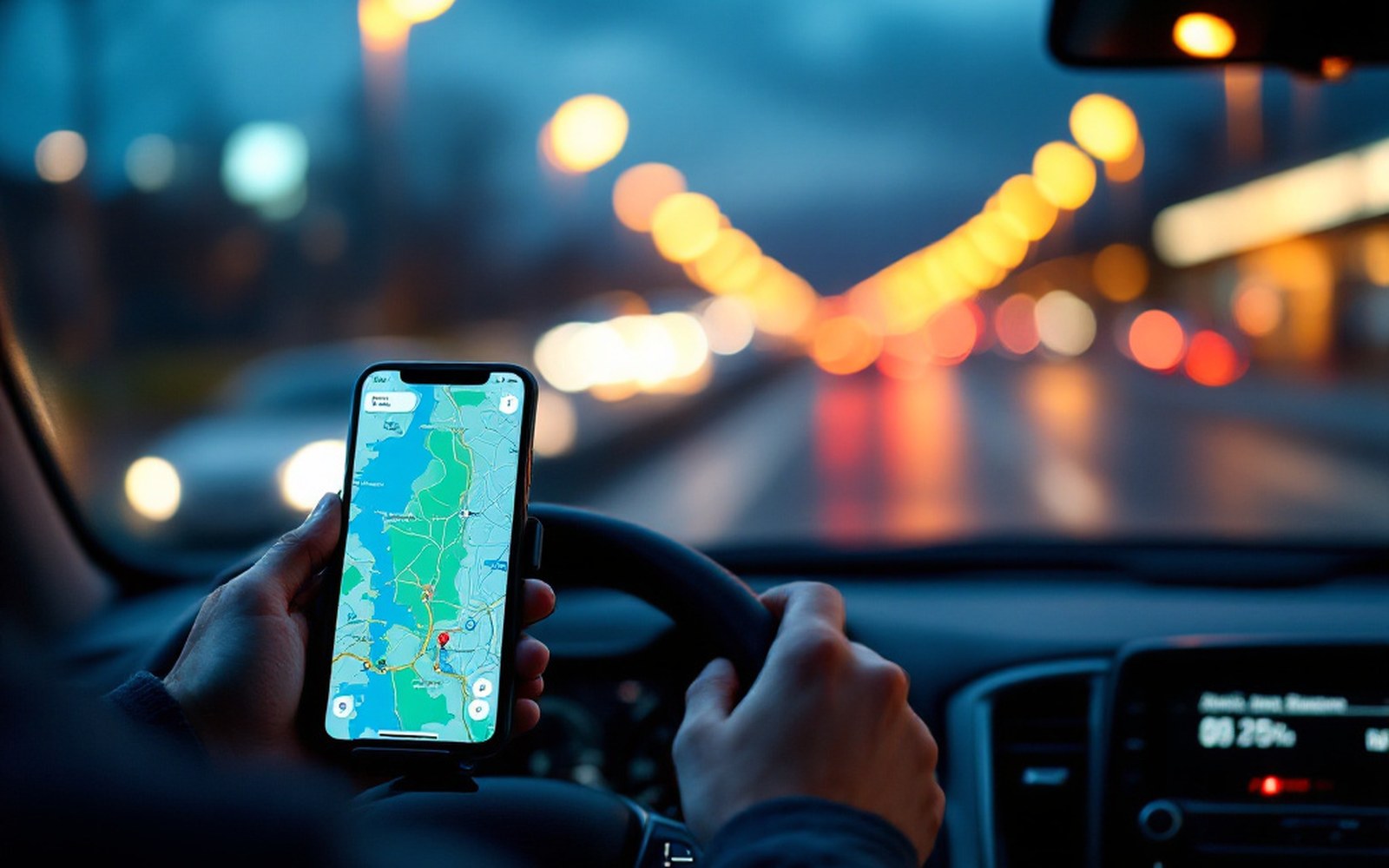
The match is settled before the engine starts. What the platform sold was not routing but recognition.
Photograph from the tripda.com picture kitThe real friction was not finding a car; it was trusting one
Before any marketplace for shared long-distance driving could price a seat or balance a route, it had to solve a more primitive problem: two people who had never met, in a car, for several hours, with no institutional chaperone. The routing algorithms were not the hard part. Mapping a corridor from Frankfurt to Paris or São Paulo to Rio de Janeiro is a deterministic calculation. Getting a stranger to commit to that journey with a private individual required something closer to social engineering — a designed substitute for the street-level cues that help a person decide whether to trust another.
The sociological shorthand for what carpooling platforms had to manufacture is thin trust: not the deep trust built over years of repeated interaction, but enough confidence to lower the cost of the first encounter. Offline, that confidence comes from context — mutual friends, institutional affiliation, a uniform, a recognisable vehicle. Online, a marketplace that cannot supply any of those things must build proxies, and the proxies have to be cheap to produce and hard to fake.
Three mechanisms did most of the work: identity verification, a reputation score accumulated from past journeys, and profile signals that turned preferences into a kind of pre-negotiated social contract. None of them was technically sophisticated. Together, they were enough.
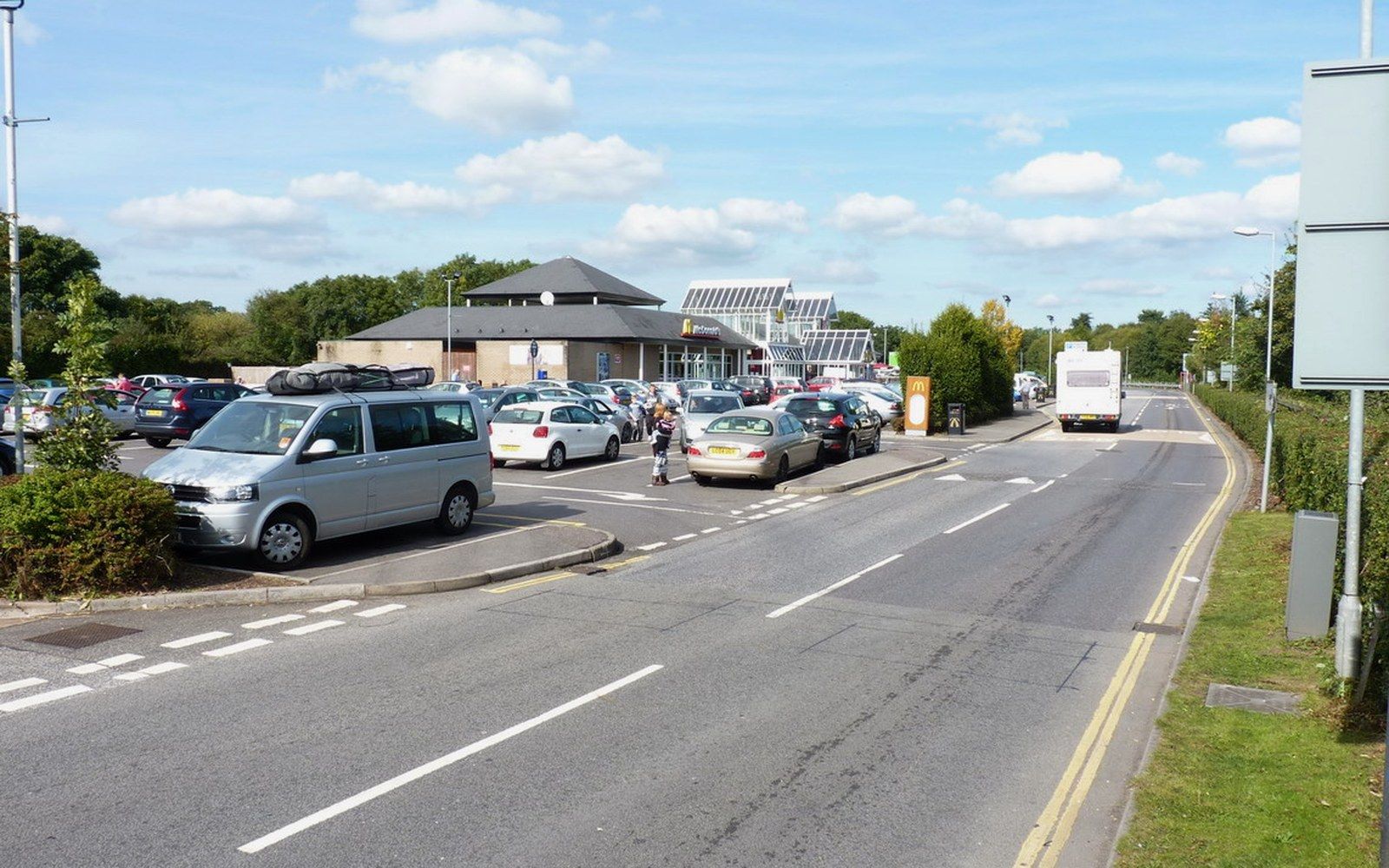
The category owns no infrastructure. It borrows this: a car park off a trunk road where two strangers agree to meet.
Photograph: Cullompton motorway service area · geograph.org.uk 3218604 · Wikimedia CommonsWhat a verified phone number actually certifies
A phone number verification does not prove who someone is. It proves that the account holder controls a specific SIM card at the moment of signup. That is a much narrower claim, and the platforms that used it — BlaBlaCar foremost among them — were careful not to oversell it in their own internal design rationale. What a verified number actually does is raise the cost of abandoning an account. Creating a throwaway identity requires a new SIM; in most markets that means a physical purchase, a small fee, and a name registered with a carrier under telecoms regulation. The friction is low in absolute terms but high relative to the stakes of a single low-value deception.
A government-issued ID check raises that cost further, and several platforms introduced it as an optional or mandatory layer for drivers. But verification depth follows a market logic: the more often a person uses the platform, the more reputation they accumulate, and accumulated reputation becomes its own collateral. A driver with forty completed trips and a 4.8 average rating has more to lose from a bad interaction than a verified ID can express. The ID matters most in the early market, when almost nobody has a rating history — which is precisely when a marketplace is most fragile.
The rating as a durable asset
A rating score is an asset in a specific economic sense: it is accumulated through effort, it generates future value in the form of bookings, and it can be destroyed by behaviour. Passengers choose between drivers partly on price and departure time; where those are equal, the rating decides. A driver with a low rating sees thinner demand at the same price, which means either reducing the price or improving the behaviour that generates ratings. The incentive is structural rather than social.
BlaBlaCar, which grew from a French platform founded in 2006 into the largest intercity carpooling marketplace by the mid-2010s, published occupancy-rate data that showed a clear relationship between profile completeness — photo, verified phone, connected social account, accumulated reviews — and booking conversion. A fully built-out profile outperformed a sparse one by a substantial margin, not because passengers consciously audited each element but because completeness read as effort, and effort read as seriousness.
The rating system had a structural bias that most users understood intuitively: scores cluster at the top. Because both driver and passenger rate each other, and because a bad rating can be retaliatory, most participants inflate. The useful information is therefore in the distribution of individual reviews rather than the aggregate score. A driver with 4.6 from 200 trips is meaningfully different from one with 4.6 from eight, and a driver whose written reviews mention punctuality is a different proposition from one whose reviews mention nothing at all. The score is the headline; the text underneath is the actual signal.
The profile is read once, quickly, at this size. Everything it has to establish, it establishes here.
Photograph from the tripda.com picture kitProfile signals as pre-negotiated contracts
The third layer of the trust system was neither verification nor score but preference disclosure. Platforms asked users to declare in advance how much conversation they wanted, whether they would carry a pet, how they felt about music, whether they smoked. These declarations served two functions simultaneously. For the passenger, they filtered the choice. For both parties, they shifted the baseline: a stated preference, visible to the counterpart before booking, converts a potential source of awkward in-car friction into an agreed-upon norm. The discomfort of saying "I'd rather not talk" is much lower when it was already declared in a profile than when it has to be negotiated in a moving vehicle.
This is the profile as a social contract — a mechanism that does real work not because it is legally binding but because it sets expectations that are costly to violate without causing visible discomfort on both sides. The design insight was that carpooling's friction was partly about the unknown duration of awkwardness. Knowing in advance that the driver prefers silence makes the silence comfortable rather than hostile.
What the system could not do
Trust infrastructure has a ceiling. Phone verification does not prevent fraud by determined bad actors; it merely prices it. Rating systems break down when participation is infrequent — a user who takes two long trips a year accumulates a rating too slowly to be meaningful, a problem that long-distance carpooling faces structurally in a way that urban ride-hailing does not. And profile signals work only if both parties read them, which requires enough platform engagement to make the pre-journey check habitual rather than optional.
What the system could do — and did, measurably, in the markets where carpooling reached genuine liquidity — was reduce the perceived risk of the first booking to a level where enough people tried it to generate the review histories that reduced risk for the next cohort. Trust infrastructure, in this sense, is a public good produced by early adopters at their own cost and consumed by everyone who follows. The verified phone number and the four-star rating are crude instruments. They were sufficient because the alternative — no signal at all — made the market impossible, and the threshold for "sufficient" was correspondingly low.
The product problem was never routing: it was making two strangers legible enough to each other that one would get into the other's car.

Reputation compounds through repetition. A long shared journey happens a handful of times a year.
Photograph from the tripda.com picture kit