Cost-sharing, and why the wording mattered
Charging a passenger for fuel rather than a journey kept intercity carpooling legal. The distinction was precise, load-bearing, and contested from the start.
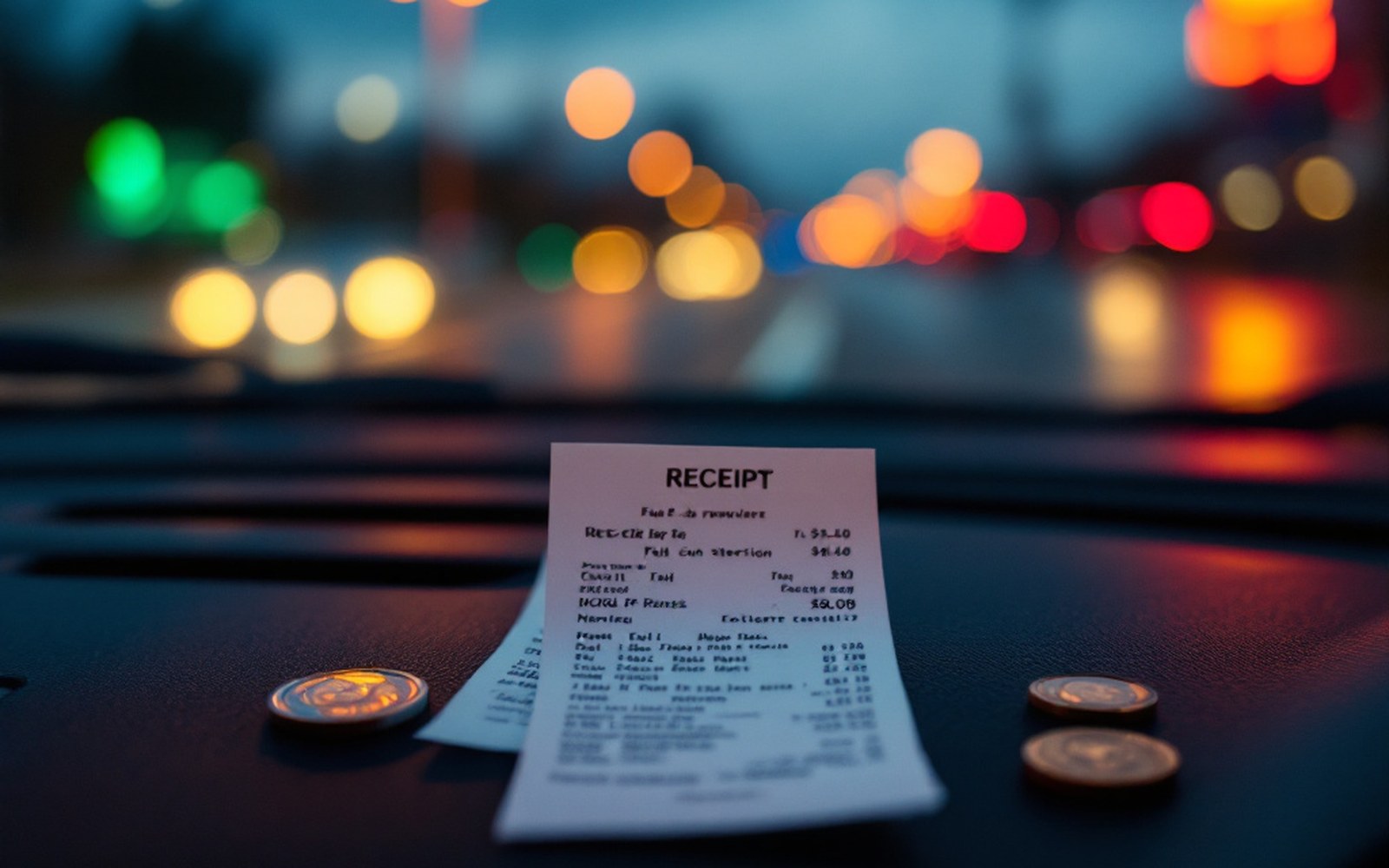
The whole legal argument sits on this dashboard: a cost already incurred, divided, not a fare charged.
Photograph from the tripda.com picture kitThe line regulators drew — and why it held
European transport law has long distinguished between carriage for hire or reward and private travel. The taxi and hire-car industries sit on one side of that line: a driver takes payment to convey a passenger, the transaction is commercial, and licensing requirements follow. On the other side sits the private motorist who happens to share a journey and splits the cost of making it. The legal architecture for that second category is old — older than the internet, older than smartphones — and it was built around a simple test: does the driver profit, or merely recover what the trip already cost?
That test is what intercity carpooling platforms rested their entire model on. The mechanism is cost-sharing in its strict sense: the driver calculates, or the platform estimates, the fuel and toll expenditure for the route, divides it by the number of seats occupied, and asks each passenger to contribute their portion. The driver receives no margin. The journey was going to happen regardless. The passenger is not buying transport; they are reimbursing a fraction of a cost already incurred.
The arithmetic matters as much as the principle. Take a 600-kilometre corridor — roughly Paris to Marseille — in a car consuming eight litres per hundred kilometres at fuel prices around €1.80 per litre. The raw fuel cost is approximately €86. Add motorway tolls, which on that route run to around €40, and the driver's total direct expenditure approaches €126. Divide by three passengers and the contribution per seat is around €42. A comparable long-distance coach fare on the same route, on the same day with modest advance purchase, might be €25–35; a low-cost airline seat could go either direction. The carpooling seat is not always the cheapest option — but it is the one that does not require a licensed carrier, because by design it does not generate carrier revenue.
Two in the front, three places behind them. The occupancy average, seen from the seat that is being counted.
Photograph from the tripda.com picture kitHow platforms enforced the boundary — and where it blurred
BlaBlaCar, which established the model that most subsequent platforms copied, embedded the cost-sharing constraint directly into its price-setting interface. Drivers were offered a suggested price derived from a standardised cost-per-kilometre formula, set deliberately below the French tax authority's reference rate for vehicle reimbursement — itself a published figure updated annually that represents a conservative estimate of what a kilometre actually costs to drive. Staying under that ceiling was the mechanism by which the platform could argue that no driver was profiting. It was not self-policing; it was enforced by the product.
Tripda, launched by Rocket Internet across roughly a dozen markets in 2014, adopted the same pricing logic when it entered markets where the regulatory question had already been argued. In Germany and France, where BlaBlaCar had already negotiated — formally or informally — the interpretation of cost-sharing rules with transport authorities, the framework was available to copy. In Brazil and other markets where intercity passenger transport regulation was structured differently, the cost-sharing argument had to be made from scratch against a different legal background. The ease or difficulty of that argument was itself a market-entry variable, not merely a compliance detail.
The boundary blurred in at least two documented ways. First, occupancy rate interacts with the arithmetic: a driver who consistently fills three seats on a round trip begins to approach, and can exceed, full vehicle-operating-cost recovery — fuel, depreciation, insurance weighting, tyre wear — not merely the marginal cost of a specific journey. Regulators in France scrutinised this, and BlaBlaCar's enforced ceiling was partly a response to that scrutiny, keeping the platform's numbers visibly inside the marginal-cost interpretation. Second, the introduction of platform fees — a booking charge paid to the platform rather than the driver — created a separate revenue stream that was clearly commercial, even if the driver's take remained within cost-sharing limits. That fee structure required its own legal treatment, distinct from the cost-sharing argument that protected the driver.
The regulatory contest that shaped the product
The significance of the wording went beyond compliance. It shaped what the product was allowed to optimise for. A licensed carrier can advertise and price transport as a service; an unlicensed cost-sharer cannot credibly price up to willingness-to-pay without risk of reclassification. This is why the platforms developed their price-suggestion tools with a downward bias and why departure-time flexibility — the driver's journey, the passenger joining it — was consistently emphasised over point-to-point transport as a product category.
Germany's 2013 deregulation of long-distance coach services reframed the competitive landscape in a way that also clarified the regulatory one: once FlixBus and its competitors were operating legally and cheaply on the same corridors, the carpooling seat was no longer the only cheap alternative to the train, and the regulatory urgency of attacking carpooling as unlicensed competition diminished. The incumbent coach and rail operators had a licensed competitor to worry about; the unlicensed cost-sharer was a secondary concern.
France produced the most sustained regulatory attention to the question. The French transport code's distinction between covoiturage — carpooling, explicitly defined in legislation as cost-sharing between a driver and passengers for a journey the driver is making regardless — and commercial passenger transport was codified precisely because the market was large enough to warrant it. The definition locked in the "journey already happening" requirement and made the driver's prior intention the operative fact. A driver who registers a journey in order to collect passengers has weakened that argument; a driver who registers a journey they were making anyway and happens to fill empty seats has kept it.
The "empty seat" framing was therefore not marketing language. It was the legal predicate. Three of the four seats in that car are empty on any average long-distance journey, and the cost of driving is incurred whether they are filled or not — that fact is what the whole pricing structure was built to reflect and demonstrate. The seat is not a product the driver is selling. It is a cost the driver is distributing.
Most of the cars on this stretch are carrying one person, and every one of them is the supply side of the market.
Photograph from the tripda.com picture kitWhat the wording cost the model
Precision has a price. Holding prices to cost-sharing levels rather than market rates meant leaving money on popular corridors on peak dates — times when a passenger would pay materially more than fuel-and-tolls for a reliable seat. The platform could not capture that surplus without reclassifying the product. It also meant the model's unit economics were structurally thinner than a commercial transport service: the platform's revenue was limited to the booking fee, not a share of a fare that could flex with demand.
That structural thinness is what made liquidity — enough drivers on the right corridors at the right times — so decisive. A cost-sharing model that cannot price up in response to demand has only one lever for matching supply and demand: volume. Which is precisely why the platforms that survived were the ones that could build and hold the density.
Pricing a seat at a share of fuel and tolls rather than as a fare is what kept the model out of taxi regulation in most of Europe.
Liquidity is not how many drivers exist. It is how many are going this way, this evening, from here.
Photograph from the tripda.com picture kit